What is xanthelasma?
Xanthelasma are fat deposits of cholesterol under your skin. These are seen as soft yellowish growths the near inner corner of your eyelids.

Dr. Nitin Ranjan
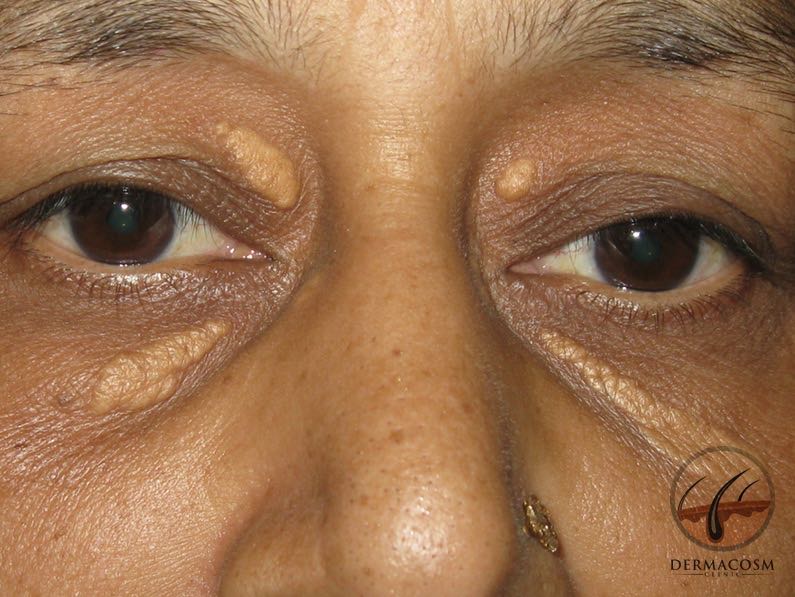
If you notice a soft yellowish growth near the inner corner of your eyelids, you might be having xanthelasma. These are fat deposits of cholesterol under your skin.
Xanthelasma patches are essentially harmless , but they are cosmetically unacceptable. Most of people seek treatment to get rid of it. Even though xanthelasma patches are not harmful, but they are indicative of disorder in lipid metabolism and risk factor for heart disease. So do not ignore them, get them properly checked by your doctor.
What causes xanthelasma?
Xanthelasma can occur in people of any race and of either sex. However, females seem to be more frequently affected than males. It mostly develops in middle age. Very often, xanthelasma patches develop in patients with high level of lipids or cholesterol. It is also possible that you get xanthelasma without elevated lipids or cholesterol levels. In fact, about 50% of patients with xanthelasma have normal lipid and cholesterol levels. The other half of the patients with xanthelasma may likely have:
- High LDL (“bad”) cholesterol or low HDL (“good”) cholesterol
- Inherited high cholesterol (familial hypercholesterolemia)
These patients are at risk of heart disease, diabetes and high blood pressure.
How is xanthelasma treated?
If you notice these patches around your eyes, do not ignore. You should see your physician or dermatologist, as these might be indicative of underlying heart disease. Lipid profile tests are usually advocated. If cholesterol is found to be high, then lipid-lowering drugs are prescribed. Other tests as ECG, fasting sugar, angiography might be advised to find out any other underlying cardiac or metabolic disease. There are many treatments available to decrease appearance of xanthelasma patches. These include:
- dissolving the growth using chemicals like trichloroacetic acid cautery
- removing the growth using electrocautery or Radio-frequency
- freezing the growth by intense cold or Cryosurgery
- excising it by surgery
- removing it by Laser
Along with of treatment of xanthelasma, it is very important to take lipid lowering drugs if you have elevated level of chelostrol. This would minimise the deposition of fats on body tissues and prevent recurrence of xanthelasma.
We treat Xanthelasma
At Dermacosm clinic, we regularly treat xanthelasma using chemical cautery with trichloroacetic acid.
What to expect from xanthelasma treatment?
As discussed above, there are number of treatment modalities for treating xanthelasma. But none of these are 100% satisfactory, there are limitations with each treatment modality.
Chemical cautery with trichloroacetic acid:
- This is one of the most common, cost effective and safest method to treat Xanthelasma.
- Patients usually experience a burning sensation for up to 5 minutes , but there is no need for anaesthesia
- With 6-8 sessions, the size of xanthelasma patch significantly decreases without scarring
- The main disadvantage is the need for multiple sittings required for an appreciable effect
Radio-frequency
- This is a cost effective method, which usually requires a single session
- Local anaesthetic is required before this procedure
- As skin around eye and eyelids is very thin and sensitive, so excision is done using low abalative power
- Working at a low ablative power and sensitive area near eyes might act as a limitation to remove the patch completely
Laser excision
- Popular method requires single session to remove xanthelasma.
- Very costly procedure
- You should visit a highly experienced laser surgeon who is capable of removing xanthelasma without risk of scarring or eye damage by laser
- Inherent risk of laser operation is damage to eyes and in extreme cases even causing permanent loss of vision. So it is highly recommended that the client wears eye protectors during laser excision.
Cryosurgery
- An effective procedure for xanthelasma removal in single session.
- Not preferred as deep cold of cryosurgery might damage eyes and there is great risk of scarring with this procedure
Surgical excision
- Removal of xanthelasma by cutting it with scalpel is oldest method of removing it in single session
- Local anaesthesia is mandatory
- Not safe as risk of bleeding, infections and scarring.
- Given all the modern techniques, it is not preferred.
— If you like this post, please don’t forget to share it with your friends.
Dermacosm Clinic, Aligarh
Dr. Nitin Ranjan · MD (Dermatology) · Daily, 9:30 AM to 2:30 PM
Book an appointment →Shop no. 1, Kaveri Apartments, Near Meenakshi Cinema Flyover, Ramghat Road